


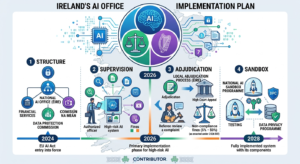
The Irish Government is rapidly advancing the Regulation of Artificial Intelligence Bill 2026. This legislation formally establishes the national framework required to supervise, monitor, and enforce the European Union’s landmark AI Act within the state. Published on June 17, 2026, the Bill has cleared all stages in the Dáil Éireann and is progressing through the Seanad Éireann (Irish Senate). The government aims to have the entire infrastructure operational by August 2, 2026, coinciding with the implementation deadline for the majority of the EU Act’s provisions.
1. The AI Office of Ireland (Oifig IS na hÉireann)
The cornerstone of the Bill is the creation of the AI Office of Ireland as an independent statutory body, scheduled to be established no later than August 2, 2026.
Structure: The office will be led by a Chief Executive Officer and a seven-member board, all appointed by the Minister for Enterprise, Tourism and Employment.
Core Functions: It will serve as Ireland’s single point of contact for the European Commission and the EU AI Office. While its initial role focuses on cross-sector coordination, public AI literacy, and supporting joint investigations, the Minister intends to officially designate it as a Market Surveillance Authority (MSA) via secondary legislation before the August deadline.
The National AI Register: The AI Office will maintain a centralized register tracking all prohibited AI practices, serious incidents involving high-risk systems, and deployments of AI components within critical digital, water, gas, and transport infrastructure.
2. A Distributed Supervision Model
Rather than concentrating power in a single super-regulator, Ireland is adopting a decentralized approach that leverages existing sectoral experts. These bodies will oversee AI compliance within their respective domains:
The Data Protection Commission (DPC): Tasked with safeguarding fundamental rights and personal data usage in AI training and deployment.
The Central Bank of Ireland: Responsible for monitoring AI systems utilized by regulated financial services and institutions.
Coimisiún na Meán: Overseeing AI integration and compliance within audiovisual media services.
3. Aggressive Enforcement and Investigation Powers
The Bill introduces robust powers for authorized officers to ensure corporate transparency and compliance:
Data and Source Code Access: Regulators can demand technical documentation, validation datasets, and training logs. If standard verification methods prove insufficient, they hold the legal right to request a system’s underlying source code. Refusal to comply is a criminal offense leading to fines or imprisonment.
Intervention Actions: Officers can issue contravention or prohibition notices, order the immediate seizure and disposal of unsafe AI products, and mandate information society service providers to remove online content associated with high-risk AI threats.
4. Administrative Sanctions and Adjudication
To guarantee due process, the Bill establishes an independent adjudication framework. If an authorized officer suspects a breach, they issue a formal notice, allowing the entity to make submissions. If non-compliance persists, the case is referred to an independent adjudicator chosen from a newly established national register.
The Penalty Scale: Fines mirror the EU AI Act’s strict thresholds. Prohibited AI practices can yield penalties up to €35 million or 7% of global annual turnover, whichever is higher. Standard compliance violations cap at €15 million or 3% of turnover, while misinforming authorities can result in a €7.5 million or 1% fine. Public sector fines are capped at €1 million.
Judicial Oversight: All adjudicator decisions can be appealed to the High Court within 28 days. Unappealed decisions must still be confirmed by the High Court to ensure legal proportionality.
5. Regulatory Sandboxes and Innovation
To prevent strict rules from stifling economic growth, the Bill permits the AI Office to launch national AI regulatory sandboxes. These controlled environments allow start-ups and SMEs to test innovative AI systems under regulatory supervision. Under strict conditions, businesses may repurpose lawfully collected personal data to train and refine their models within the sandbox, with the DPC directly involved in oversight.