


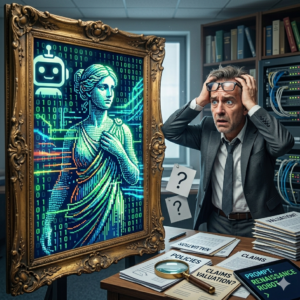
AI in a Gilded Frame: Why Art Insurers Are Breaking a Sweat
We typically view fine art insurance as a straightforward process involving a canvas, a signature, and clear provenance. But what happens when an algorithm “paints” the artwork? In this case, a text prompt replaces the traditional brush.
Ever since the Edmond de Belamy portrait sold for over $430,000 at Christie’s, AI art has entered high-end galleries. However this shift creates a massive underwriting headache. Consequently, the industry faces four major hurdles:
The Authorship Puzzle: Traditional insurance relies on human creation. Because AI art blends the prompter, coder, and machine, authorship is now blurred. Therefore, establishing legal “insurable interest” has become a nightmare for lawyers.
The “Ctrl+C, Ctrl+V” Factor: Scarcity drives the value of fine art. Nevertheless, an AI can generate a thousand similar versions in mere seconds. To address this, insurers are exploring blockchain and NFTs to prove an item is unique.
The IP Minefield: Legal battles now center on whether AI models “stole” skills from copyrighted datasets. If an insured work is flagged for infringement, the question of liability remains. Currently, most policies cannot handle this “algorithmic plagiarism”.
Digital Fragility: Many AI pieces depend on specific servers or software. Should a hosting platform go bust, the artwork could become inaccessible. As a result, technological shifts directly threaten the asset’s value.
The Bottom Line: AI art remains insurable, though the process is increasingly complex. Right now, the industry is busy rewriting its rulebooks. Soon, surveyors may spend more time auditing training data than examining physical brushstrokes.