Telegram Channel

More...

Generic selectors
Exact matches only
Search in title
Search in content
Post Type Selectors

More...

Generic selectors
Exact matches only
Search in title
Search in content
Post Type Selectors

More...

Generic selectors
Exact matches only
Search in title
Search in content
Post Type Selectors
Only letter and space (from 2 till 30 characters)
Enter correct number, ex. +380777777777

Lawyer's Blogs

Trademark Updates for 2026: What Changes in the UK, US, EU and Canada

Published:   14.10.2026 |

The international brand protection landscape is shifting in 2026. For companies scaling across borders or managing multi-jurisdictional IP portfolios, this means stricter procedures, closer scrutiny and new government fees. For this reason, below is a breakdown of four regional updates that corporate legal teams and executives should review now. United Kingdom: official trademark fees go up To start with, the UK Intellectual Property Office (UKIPO) has made its first major fee adjustment in over a decade. What changed. The online application fee for a single-class trademark has risen from £170 to £205. Other fees have moved as well: each additional class: from £50 to £60; trademark renewal: from £200 to £245; opposition and revocation proceedings: up by approximately 25%. Business impact. Budgets that ignore these increases may fall short. In addition, a missed renewal window can mean lost priority rights or an inadvertent lapse of UK protection. So it is worth updating forecasts and renewal calendars now. United States: stricter domicile rules and AI specimen audits The US Patent and Trademark Office (USPTO) has stepped up its verification process. The aim is...


AI Act: What Article 50 Changes and What New Obligations Businesses Face. Part 1

Published:   07.10.2026 |

Artificial intelligence has become part of everyday business processes. Companies use AI to communicate with customers, create content, run marketing, analyse data, automate internal workflows and develop new products. But with the technology comes a new question for business: must a customer, employee or other user be told that they are interacting with AI, or that content was created or altered by artificial intelligence? Article 50 of the EU Artificial Intelligence Act (AI Act) answers this question to a large extent. Since 2 August 2026, its transparency requirements have been legally binding. The European Commission has also published separate Guidelines explaining how these provisions apply in practice. It is important not to read Article 50 as a simple rule that "everything created by AI must be labelled". In fact, the law sets different obligations for different situations and for different players in the AI chain. Who Article 50 applies to The AI Act is built on a risk-based approach. Depending on the nature and level of risk, AI systems fall under different regimes, from a ban on certain practices to minimal requirements. Article 50 is aimed mainly at systems where...

AI in Advertising: Do You Need to Tell Consumers That an Ad Was Created by AI?

Published:   01.10.2026 |

Not long ago, the question of AI in advertising mostly came down to how much faster and cheaper an ad creative could be made. Today businesses face a different question: where does ordinary use of the technology end and the legal duty to tell consumers that they are looking at the work of artificial intelligence begin? This matters most for international campaigns. The same AI-generated ad can run in the UK, the EU and other jurisdictions at once, while transparency requirements already differ between them. The main mistake is to think that a small "AI-generated" label settles the matter. In many cases the problem is not that the ad was created by AI, but what the ad tells the consumer. AI does not exempt advertising from the usual rules The UK has no general rule requiring every image, video or text created with AI to be specifically labelled. That does not mean an advertiser can use AI without legal risk. The position of the UK regulator, the ASA/CAP, rests on media neutrality: the way an ad is made does not change the rules that apply to it. AI may change how ads are produced, but it does not change the requirements for accuracy and compliance with the advertising...

A Cypriot Company Has Breached a Contract: Where and How to Protect Your Rights?

Published:   16.09.2026 | blog

When a Cypriot counterparty fails to perform a contract — fails to pay for goods or services, misses deadlines, refuses to fulfill obligations, or terminates the agreement prematurely — the question arises as to where and how you can protect your rights. For such a dispute, it is not enough to simply establish that the defendant is registered in Cyprus. It is necessary to review the contract terms, jurisdictional rules, governing law, nature of the breach, evidence, and the prospects of debt recovery. Can You File a Lawsuit in Cyprus? In many cases, yes. The defendant’s location is one of the primary grounds for establishing jurisdiction. However, this is not the only rule. In contractual disputes, jurisdiction can also be determined by the place of performance of the obligation. Under Brussels I bis, for contracts involving the sale of goods, the relevant location is where the goods were delivered or should have been delivered; for service contracts, it is where the services were provided or should have been provided. Therefore, before filing a lawsuit, it is necessary to identify all potential grounds for jurisdiction and verify whether the parties agreed...

AI in the Workplace: Navigating the EU AI Act

Published:   09.09.2026 |

Artificial intelligence has rapidly transitioned from an experimental HR tool to a core engine for talent acquisition, performance tracking, and workforce management. Employers worldwide now rely on AI algorithms to screen resumes, analyze candidate interviews, monitor employee productivity, and even inform promotion or termination decisions.However, the regulatory honeymoon phase is officially over. With the enforcement rollout of the landmark European Union Artificial Intelligence Act (EU AI Act), workplace AI tools are facing unprecedented statutory oversight.Crucially, this is not just a European issue. Due to the law's extra-territorial reach, any global enterprise utilizing AI to hire, monitor, or manage candidates or employees residing in the EU must comply, regardless of where the employer’s headquarters are located.Below is a strategic analysis of how the EU AI Act impacts workplace technology and the action plan employers must execute to ensure compliance.1. The High-Risk Classification: Why HR Systems Are in the Regulatory CrosshairsThe EU AI Act adopts a risk-based approach, categorizing AI applications into prohibited, high-risk, limited-risk, and minimal-risk...

CJEU: Trust Structures Do Not Shield Assets from Sanctions

Published:   26.08.2026 |

On 21 May 2026, the Court of Justice of the European Union delivered two important rulings (Cases C-483/23, C-428/24 and C-476/24) that may significantly affect the application of EU sanctions law. The Court confirmed that the use of trust structures does not, in itself, prevent assets from being frozen where a sanctioned person retains the ability to exercise control over those assets or derive an economic benefit from them. The Cases and the Applicants’ Arguments The cases concerned assets held through trust structures: The first case: It concerned four Italian companies whose ultimate owner was a Bermuda company held in an irrevocable trust. The settlor of the trust was included on the EU sanctions list, although he had formally been removed from the class of beneficiaries shortly beforehand. The other two cases: The disputes concerned the assets of an Italian company and a superyacht worth approximately EUR 530 million, which were also held in trusts. The trust deeds contained specific provisions prohibiting the trustee from making any payments to a person subject to sanctions. The applicants argued that, under these circumstances, the sanctioned person...

Jersey Guide. How Jersey Companies Handle Distributions: Rules, Requirements, and Director Risk

Published:   19.08.2026 |

Jersey offers an adaptable framework for corporate distributions under the Companies (Jersey) Law 1991. Unlike jurisdiction rules that restrict dividends strictly to accumulated net profits, Jersey allows companies to distribute cash or assets from a much broader range of financial accounts, provided specific statutory safeguards are met.What Qualifies as a Distribution?Under Jersey law, a distribution includes any transfer of cash or company assets to shareholders in their capacity as shareholders. It excludes:Bonus share issuesShare redemptions or buybacksReductions of capitalFinal distribution of assets during a winding-up processTransfers made at full market value or upstream guarantees that do not create a recognized accounting liability generally sit outside these rules. However, non-commercial loans, interest-free credit, or sales at an undervalue to shareholders can be treated as distributions and require formal authorization.Core Conditions for PaymentTo execute a distribution legally, a Jersey company must fulfill two main criteria:Solvency Statement: Authorizing directors must formally confirm that the company can pay its debts as they fall due immediately after the...

Dot-Com 2.0 or Strategic Peak? Decoding Wall Street’s Market Euphoria

Published:   22.07.2026 |

Wall Street is currently staging a masterclass in market momentum, driving equity valuations to historic peaks. However, beneath the soaring ticker symbols, top financial analysts are identifying classic indicators of an overheating market—drawing striking parallels to the dot-com era of the late 1990s.Market Valuation Metric: S&P 500 Price-to-Sales Ratio Current Level: >3.3x (Historical Record High) Analyst Assessment: "Euphoria Territory" (Barclays Indicator) Key Highlights of the Market RallyTrillion-Dollar Milestones: Tech powerhouses continue to anchor market optimism. Nvidia recently broke records by becoming the first public company to achieve a $4 trillion market capitalization, driven by relentless demand for AI infrastructure.The Return of Meme-Stock Velocity: Retail trading enthusiasm has re-ignited, generating explosive upside for legacy retail picks like GoPro and Krispy Kreme.High-Yield & Crypto Acceleration: Crypto assets have reached unprecedented adoption levels, with Bitcoin crossing $120,000 for the first time. Simultaneously, enterprise players like Palantir (+140% since April lows) and Coinbase (+180%) are riding strong government contracting...

Ireland Fast Tracks Landmark Bill to Enforce EU AI Act

Published:   13.07.2026 |

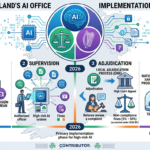
The Irish Government is rapidly advancing the Regulation of Artificial Intelligence Bill 2026. This legislation formally establishes the national framework required to supervise, monitor, and enforce the European Union's landmark AI Act within the state. Published on June 17, 2026, the Bill has cleared all stages in the Dáil Éireann and is progressing through the Seanad Éireann (Irish Senate). The government aims to have the entire infrastructure operational by August 2, 2026, coinciding with the implementation deadline for the majority of the EU Act's provisions.1. The AI Office of Ireland (Oifig IS na hÉireann)The cornerstone of the Bill is the creation of the AI Office of Ireland as an independent statutory body, scheduled to be established no later than August 2, 2026.Structure: The office will be led by a Chief Executive Officer and a seven-member board, all appointed by the Minister for Enterprise, Tourism and Employment.Core Functions: It will serve as Ireland's single point of contact for the European Commission and the EU AI Office. While its initial role focuses on cross-sector coordination, public AI literacy, and supporting joint investigations, the Minister...

Why a Company Secretary in Cyprus is Not Just a Formality: Our Firm’s Insight

Published:   08.07.2026 |

Hello everyone! Today we are diving into a topic that many international entrepreneurs completely overlook when setting up a business in Cyprus.When clients come to us to register a company, they spend days choosing directors, distributing shares, and mapping out ultimate beneficial owners (UBOs). But when it comes to appointing a Company Secretary, they often treat it as a mere bureaucratic formality. From our practice, this is a massive mistake that can lead to serious compliance pitfalls, delays, and corporate governance issues down the road.Let us break down exactly what a corporate secretary does under Cyprus law and why this role is the backbone of your business administration.Is a Secretary Legally Mandatory?The short answer is: yes, absolutely. Under the Cyprus Companies Law, Cap. 113, every single incorporated entity must have a company secretary from day one.Here are the basic rules:The secretary must be at least 18 years old.It can be either an individual or a corporate entity, which is why many clients choose our team to act as their corporate secretary to ensure professional oversight.Generally, the roles of director and secretary are separate. There is only one...